Monday, May 1, 2023

The World Bank backed law of security rights in movable assets in Ethiopia has flaws that need to be addressed urgentl

June 19, 2023

Asress Adimi Gikay(PhD)

Addis Abeba, June 9, 2021 – The Ethiopian Parliament enacted a modern law governing security rights in movable assets in 2019. The Movable Property Security Rights Proclamation was drafted with the assistance of the International Finance Corporation (IFC). Enacted in response to the dire need of the Ethiopian financial sector as well as small and medium-sized enterprise for a comprehensive law governing collateralization of movable assets that is pivotal to enhancing access to credit, the law permits borrowers to use many types of assets including vehicles, agricultural goods such as crops, equipment, and incorporeal assets such as intellectual property rights and accounts receivables as collateral.


The new legal framework also mandates the establishment of a Collateral Registry Office in charge of registering all security rights in movable assets, filed exclusively online. Undoubtedly, the new legal framework would give businesses and consumers a better opportunity to access credit at a low cost by granting security rights to creditors in a broad range of movable assets, in contrast with the previous  obsolete legal regime that had unclear provisions regarding many types of security rights. It also creates a single collateral registry system and efficient enforcement rules. But this law also has certain shortcomings that may cause practical challenges, and in some cases with grave socio-economic consequences. The law is based on Article 9 of the Uniform Commercial Code of the United States and has certain components whose compatibility with the Ethiopian current socio-economic context is questionable, even by the standard of the US law itself. The drafting process also lacked transparency to the broader stakeholders, including advocacy groups, scholars, and the public at large. 


The transparency deficit

When the law governing security rights was being drafted, there was a fair amount of opaqueness that prevented sufficient scrutiny of the draft by the broader Ethiopian stakeholders. A letter soliciting comments, to which the bill was annexed, sent out by the Ethiopian National Bank on November 17, 2017, was addressed to the Ethiopian Bankers Association, Ethiopian Lawyers Association, and the Association of Ethiopian Microfinance Institutions. Other stakeholders, albeit not explicitly excluded, were officially unaware of the draft law and its impact on them, or the interest groups they represent. 

This area of law has been in place since 1960 when the Ethiopian Civil Code and Commercial Code were enacted primarily based on French legal tradition. 


Given the novel approach adopted by the new law and its potential implications for consumer debtors and the society at large, the National Bank as well as the IFC, should have set up a public consultation and feedback system, rather than to allow a small group of consultants and lawyers to determine the suitability of a law that would affect millions of citizens. Public consultation during law making process is conducted on all legislative proposals in other jurisdictions such as the European Union and the United Kingdom because citizens and other stakeholders who would be directly impacted by the law have equally high stake as the expert drafters or other elite groups and should be given the opportunity to contribute to shaping the  policy behind the law. The Organization for Economic Cooperation and Development recommends the lawmaking process to be based on public consultation, among others, to ensure legitimacy and credibility of the process, to promote legislative literacy and  compliance as well as to ensure that the law takes into account public interest. 


Unfortunately, this core principle in the legislative process has been flouted by those involved in drafting the law of security rights in Ethiopia. Based on the circumstances surrounding the process, it was unclear whether this opaqueness was advised by the IFC, or the individual consultants involved in the process.  To be clear, all stakeholders involved in the process should share the responsibility. The IFC being the investment wing of the World Bank, has its own interest which does not align with the interest of the broader Ethiopian stakeholders such as small businesses, farmers, and consumers, which might partly explain why the draft law was not subjected to adequate public scrutiny. 


Both as reform advocate and an investor in diverse sectors and a potential creditor, the IFC would undoubtedly want to promote creditor-friendly laws, apparent in some of the proclamation’s harsh rules of enforcement of security rights with in no legal remedies for debtor’s subjected to abuse by creditors. Thus, the strictly managed and partially transparent legal reform process could have been dictated by the need to preserve the self-interest of the IFC, by protecting the problematic legal provisions that it aggressively advocates for from criticism and potential revision.


Driven by my research interest in the field and having multiple publications covering reform in this area, I emailed the lead consultant Dr. Marek Dubovec on January 25, 2018, requesting the draft proclamation. A day later, he informed me he was not at liberty to share the draft law with me, although we were acquaintances that have been on good terms. In his response, he stated, “It is the prerogative of the drafting group to decide how and with whom to share the draft Proclamation. I am not at liberty to circulate the draft Proclamation.” This was shocking to me given the fact that a draft law which is closer to being enacted by the parliament of the country and being already circulated for feedback should be available to any interested citizen. 


Two years after the law was enacted, I published the first comprehensive book covering the law where I demonstrate that several important provisions of the law are simply not fit for Ethiopia; in some cases obsoletes concepts copied from US Law while in others, legal rules that are proven not to function even in the US being imported without further thought . Unfortunately, the opaque process of legal drafting and deliberation has allowed the many problematic provisions to be enacted without the essential scrutiny and revision. 


Technological challenge

The new law mandates the establishment of an exclusive electronic collateral registry in a country that suffers from insufficient electricity and internet access. The National Bank now runs the electronic collateral registration system and there is no adequate data to evaluate its accessibility to the broader stakeholder. But according to World Bank data, in 2018, less than 50% of the total population of Ethiopia has access to electricity while less than 22 Million People will use the internet in 2020. The infrastructure necessary for the proper functioning of the electronic collateral registry is not present in Ethiopia today. Even in the United States, a country whose law the proclamation is modeled on; some states including New York still administer paper-based registration parallel with electronic registration. 


Essentially, this law, which assumes that Ethiopia is technologically more advanced than New York, would not be fully functional for the Ethiopian farmers or rural dwellers, the great majority of whom are either poorly literate or have no access to electricity and the internet. This defeats the overall purpose of the new law, which is to allow all Ethiopians to have access to finance through using their movable assets as collateral and to have a registration system that works for all. 


Since the National Bank’s Collateral Registry Establishment Directive does not cover paper-based registration system and in the absence any other legislation that is not repealed by the new law, it is impossible to understand what the government thinks about registration of collateral in rural Ethiopia where access to the Central Collateral Registry is impossible.   


Threat to Due Process of Law

The new law potentially deprives citizens of due process of law. It allows the secured creditor (e.g., a bank) to take possession of the collateral (upon the debtor’s default). This procedure known as self-help repossession, pioneered in the US, is largely unfamiliar in Ethiopia. But even the Americans subject it to strict ex post facto court supervision with many rules protecting consumer debtors including the requirement of repossessing the property peacefully, and the harsh criminal and civil penalties for breaching the peace. In the State of Louisiana which has similar legal tradition as Ethiopia, the procedure is strictly regulated to ensure that public peace is observed by the creditor when taking the collateral from the debtor. More precisely, in Louisiana, the procedure is allowed only if the collateral is a Motor Vehicle, and the creditor gives an advance notice to the debtor that states, “Louisiana law permits repossession of motor vehicles upon default without further notice or judicial process.” Nevertheless, the creditor must conduct the repossession peacefully in all cases. 


Under Ethiopian law, the creditor can take possession of the collateral upon the debtor’s default without giving advance notice as far as the debtor has signed an agreement at the time of securing the loan. A repossession clause in the loan agreement that might not have been presented to the consumer in clear and comprehensible manner can subject the consumer to such a harsh private system of justice. Even if there is no prior agreement, the creditor can try to take the property, and if the debtor does not protest, the process can be conducted. The law also empowers the Collateral Registry Office to order the police to assist the creditor in repossessing the collateral. There is no legal avenue for the debtor to challenge any misconduct that may occur during the process. If, for instance, the debtor thinks that they have not defaulted, there is nothing they can do; once they have signed the repossession agreement when they obtained the loan.  


In the United States, despite the high threshold for conducting collateral repossession, the occurrence of confrontation between repo men (person’s repossessing the collateral) and debtors ending in tragic deaths or serious bodily injuries is common. Sometimes the repo men shoot the property owners dead. Other times, the property owners take the repo men’s lives first. These kinds of incidents may not be likely to occur in Ethiopia due to the inaccessibility of firearms among the Ethiopian people. But possible violent conflicts of various degrees between debtors or family members of debtors’ and the repossession agent/the police would be inevitable. Besides this, the law confers a judicial power upon the Collateral Registry Office which can compel the debtor to transfer the property to the creditor, even if there might be a controversy regarding default and payment. This may arbitrarily deprive consumers of their property right and the right to due process of law.

In a country with low literacy level, low respect for rule of law, a high tendency for abuse of power, and police violence, the fact that this proclamation creates a collateral registry office with the power to order the police to execute decisions not passed by courts should be concerning to all Ethiopians. 

An all-inclusive revision process

A country that has limited resources should strive to implement important legal frameworks with careful thought involving in-depth legislative research and wider public participation, rather than rushing a bill that is barely scrutinized by the public through the floor of the Parliament, only to end up engaging in premature revision. The law governing security rights in movable assets has a plethora of substantive issues that require urgent legislative attention, besides its failure to take into consideration the interests of consumer debtors that require protective legal rules. 


The Ethiopian government has timely and rightly recognized this area of law as vital to enhancing economic development.  Now it is time to recognize that this law has been drafted and passed in dubious circumstances and lacked the required level of transparency which led to provisions that are inapt to the Ethiopian socio-economic context being enacted by the parliament. The government should recognize this and support a revision process owned not just by the elites but by the wider public. AS


This article was first published in Addis Standard



Security forces’ attacks on the Aari threatens South Omo’s harmony

9 May, 2022


Asress Adimi Gikay


The de facto criminalization of identity in the zone is a challenge to lasting peace.

 The Aari people, as the most populous group in South Omo, have been leading an agenda for the zone to become a regional state for some time now. As this was essentially opposed by the federal and regional governments, making it politically impractical despite unrestricted constitutional self-determination rights, they instead made a demand for the four Aari weredas to become a zone.

Although the demand is contentious, the Aari leaders at the forefront of this movement believe that the proposed restructuring is a partial answer to the community’s socio-economic and developmental challenges, as it will give them control over the budget received from the Southern Nations regional government. 

The advantage of regional status for South Omo would have been receiving a budget directly from the federal government, managing resources locally, and delivering administrative services in South Omo rather than requiring a trip to Hawassa.

On 10 April, political unrest related to the self-rule request led to a tragic loss of life and property. Over 150 homes were destroyed by fire, while around 1,000 people were displaced, including women, children, and the elderly. While this initial violence caused no deaths, security forces later reportedly killed five Aari youth

The conflict has impacted various towns in South Omo, including Gazer, Metser, Shishire, and Tolta. The concerted efforts of local, regional, and federal security forces brought the unrest under control, with no further communal violence occurring since. Stakeholders, including the zonal administration, are working to restore lasting peace while raising funds to support victims.

The vast majority of Aari people, including influential elders, traditional figures, community leaders, and intellectuals, condemned the violence, which was perpetrated by segments of the Aari youth who twisted a legitimate political cause to commit arson, loot, and disturb the peace. Since, the Aari community has mostly been collaborating with security forces to bring the offenders to justice.

Ethnic targeting

Yet rather than focusing on administering justice and fostering reconciliation, members of the Ethiopian National Defence Force and the Southern Nations Special Police have also been perpetrating grave human rights violations.

The scale of the abuses and the continued presence of a military command post in South Omo—where no further communal violence is expected due to the widespread condemnation by the community—raises questions about the intentions of the security forces and their backers.

The crimes perpetrated by a segment of Aari youth do not represent who the Aari people are. The Aari generally live in harmony with the more than sixteen other ethnic groups living in South Omo, due in part to the Aari people’s commitment to diversity, peace, and stability. 

But, it seems that certain elements who identify as non-Aari are using the unrest as a pretext to subjugate and disenfranchise the Aari people and so prevent them from organizing political institutions of their choice in a constitutional manner.

Media campaign

Media platforms that stir up artificial divisions between urban and rural residents are serving as a tool to tarnish the image of Aari community leaders and intellectuals, while peace-loving and hardworking individuals are harassed at the workplace due to their identity.

There is a widespread campaign involving accusations of crimes without evidence against any Aari who is widely perceived to be an important member of the society. Hundreds of Aari youth, including business owners, school teachers, university students, and lecturers, have been arrested for no justifiable reason based on the suggestion they were directly or indirectly involved in the violence.

These arrests usually came after social media outlets focused on South Omo published photos of individuals considered to be important in the Aari community and recommended that they be arrested. Some on social media seem to consider wearing traditional Aari dress and advocating peacefully for an Aari Zone as evidence of criminality. 

We need your support to analyze news from across Ethiopia

Top of Form

Prominent Aari personalities, including former President of Jinka University, Professor Gebre Yntiso Deko, who has made immeasurable contributions to development in South Omo, have been subjected to concerted defamation campaigns by platforms such as Ethio Mereja, Ethio Omo, and others that have a large local following. 

The renowned Aari singer Tariku Gankisi, commonly known as Dishta Gina, has also been torn apart by attacks against his reputation as he was labelled an organiser of the violence.  Dishta Gina is a song about the Aari New Year festival that has a message of unity, peace, love, and tolerance. 

It was remixed by Senegalese-American singer Akon, including the powerful line, “let’s fight together, and not each other”.  Tariku is also famous for speaking against the war in Tigray in a concert organised by the Ethiopian government on 7 November to rally support for the military. 

Recently, although Tariku actively tried to prevent the violence in South Omo, he was falsely portrayed on social media to have been a mastermind of it. 

Such platforms sometimes publish fabricated information that seems designed to persecute the Aari and undermine their political struggle. The peaceful majority is then unjustly assessed as being guilty by association. The strategy appears designed to disenfranchise over 400,000 people by silencing their leaders.

State violence

Despite the absence of any violence or threat of violence since the incident first occurred, security forces from the command post continue to arbitrarily detain Aari youth, subjecting them to beatings and torture.

Over 800 people have been arrested so far in relation to the unrest, most having no direct or even indirect links to the crimes. Several Aari youth have been killed under circumstances where the use of lethal force was unjustified and unnecessary.

On 28 April, representatives from the Ethiopian Human Rights Commission visited some of those under police custody and hospitalized due to injuries from gunshots and beatings by security forces. The commission is expected to release a report in due course.

A staggering number of individuals have been tortured through beatings and being stabbed by sharp ended guns. I verified that some have suffered permanent injuries to vital organs, such as their kidneys and bladder, and cannot urinate without medically administered tubes. Others have suffered serious head trauma and have been bleeding from their ears for days.

Brutal message

Security forces neutralized the political unrest, violence, and any threat in a few days with the support of Aari community leaders. The fact that they are still engaging in horrific violation of human rights indicates a concerted effort to disenfranchise and subdue the Aari.

Besides being unconstitutional and unacceptable, this will create further tensions between communities in the zone.

Shockingly, those visibly injured in hospitals are only part of the story. Others have been tortured in police stations and transferred to prisons, where information about their condition is unattainable. Many youths who have nothing to do with the violence are hunted down, beaten, and tortured, as I verified during a recent visit to the zone.

As an Aari, I have condemned the arson, looting, and breach of the peace. I have visited victims in my hometown, Metser, who are temporarily sheltered in a church. In addition to providing material support, it is also my moral obligation to condemn the human rights abuses inflicted against people by federal and regional security forces.

The level of brutality and the continued use of force against peaceful citizens suggests that those backing the security forces are committed to taking vengeance against the population at large and are sending the message that even raising political questions in a peaceful manner will have severe consequences.

Peace and stability

Ethiopia is known for its diversity of ethnicity, language, and culture. While this diversity has posed a significant challenge to the country’s peace and stability due to repeated identity-based conflicts, there are a few areas—such as South Omo Zone—where diverse peoples co-exist peacefully. 

Over the years, while many parts of Ethiopia have witnessed identity-based political conflict, South Omo has been largely immune to them, although it does experine resource-driven violence. The Aari people, being the ethnic majority in the zone, play a significant role in maintaining this tranquillity.

Those who come from the zone live by the motto, “wherever you are born, be raised in South Omo.” This self-praising phrase reflects a cultural exceptionalism in the zone that allows anyone to quickly mingle and live in harmony with others.  

The incident that took place on 10 April is therefore at odds with the longstanding culture and tradition of the Aari people and those of South Omo. Recognizing this, many influential figures—such as the head of the zonal administration, Nigatu Dansa—appealed to various stakeholders, including the federal and regional governments, local communities, and diaspora, to do their part in providing support to the victims and restoring calm.  

Inclusive reconciliation

Reconciliation and peace processes should be all-inclusive. Equally important, the current tactics of radical divisive groups who use social media to exclude and silence the Aari must cease.

Lasting harmony cannot be delivered only by bringing perpetrators to justice and upholding the rule of law. Post-conflict law-enforcement activities by the government and any actions taken by individuals or communities should focus on ensuring continued co-existence.

Besides prosecutions, it is important to address the root causes and focus on ways to live together and prosper. If reconciliation and dialogue efforts are not genuine, transparent, fair, and inclusive, the socio-political tensions in society will only be suppressed temporarily.

Currently, the situation in South Omo is set to create more injustice and strife rather than pave the way for reconciliation. The horrific human rights abuses by security forces, the arbitrary arrest of Aaris, defamation campaigns against prominent community members depicting the Aari as extremist and racist, and the intimidation of people who have peacefully exercised their constitutional rights serve no purpose.

 Appeal to authority

Violence begets violence and breeds hatred. The solution to the challenges in South Omo is all-inclusive dialogue and reconciliation. To achieve sustainable peace and stability, the following six essential measures should be adopted. The federal government, including the Office of the Prime Minister, should play an active role in coordinating these measures.

·         First, the military command post must be terminated, as it has achieved its purpose and is no longer needed. The command post played a vital role in suppressing violence and protecting the community. Having completed its mission, it has been engaging in human rights abuses that have a detrimental effect on peace and social cohesion.

·         Second, all stakeholders should refrain from stirring hate and division. Those who have good intentions for the people of South Omo should build bridges between various communities rather than destroying them. The deliberate online tarnishing of the reputation of individuals who have made a significant contribution to community development should be condemned and rejected by society because, as it currently stands, individuals who could play a constructive role in reconciliation are being excluded. 

·         Third, ethnic-based hate speech and provocation must be rejected by society and the government should organize an awareness campaign to this end. The government should get involved to ensure that toxic actors are revealed and their campaign of disinformation and defamation is exposed.

·         Fourth, the tendency to exclude the Aari community from the peace process by systematically arresting their educated and influential leaders should end immediately.

·         Fifth, the government should create a platform for urgent all-inclusive, transparent, and genuine dialogue.

·         Sixth, all perpetrators of the crimes still at large should be brought to justice in a collaborative effort by the community and all of the stakeholders.

Worryingly, the challenges in South Omo are relatively insignificant compared to those in many other parts of Ethiopia. Perpetual violence is unlikely as the community has stood together, both now and in the past, to reject inter-communal conflict. But if the federal and regional governments do not make the right decisions swiftly, taking into consideration the realities in the zone, South Omo may prove to be yet another hotspot for unrest and instability in Ethiopia.


This article was first published on Ethiopia Insight.


Facial recognition: why we shouldn’t ban the police from using it altogether

100% accurate? varuna
Asress Adimi Gikay, Brunel University London

The UK police are being accused of breaking ethical standards by using live facial recognition technology to help fight crime. A recent report by the University of Cambridge into trials of the technology by forces in London and south Wales was particularly concerned about the “lack of robust redress” for anyone suffering harm. It spoke of the need to “protect human rights and improve accountability” before facial recognition is used more widely.

The Cambridge team wants a broad ban on police using the technology, and they are not alone. UK civil liberties group Big Brother Watch has been running a “stop facial recognition” campaign as the government mulls how to regulate AI technologies. Meanwhile, 12 NGOs recently called on EU legislators to completely ban it, along with various other forms of biometric identification, in their upcoming AI Act.

Simply banning this technology would be a mistake, however. In my view, there’s a good case for a more measured approach.

Growing police use

The police forces in London and south Wales appear to be the only two in the UK currently using live facial recognition, which uses artificial intelligence software to compare an individual’s digital facial image with an existing facial image to estimate similarity. Manchester Police trialled it but were forced to pause by the surveillance camera commissioner in 2018 for not obtaining the necessary approvals.

In 2020 an appellate court also ruled against south Wales’ use of the technology, concluding the force’s legal framework for deployment effectively gave them unlimited discretion to do so. It made no difference to the court that the police had notified the public (known as overt operational deployment).

Despite this ruling, facial recognition can still broadly be used by police, although numerous other forces have said they are not doing so at present.

Woman on phone while numerous people behind her are being scanned by facial recognition technology
Any UK police force can use facial recognition under the current legal framework. Trismegist San

The London Metropolitan Police increasingly use facial recognition to locate missing persons, suspects, witnesses and victims. They have scanned individuals’ faces in city squares and at public events, using a facial recognition camera typically placed on a police vehicle or street pole. The public are alerted to the deployment through notices as they enter the recognition zone – unless that compromises policing tactics or deployment is urgent.

Between February 2020 and July 2022, the Met deployed the techology in eight locations including Piccadilly Circus. They are estimated to have viewed more than 150,000 faces, leading to nine arrests but also eight occasions where they targeted the wrong person.

The pros and cons

Facial recognition has evolved in recent years, for instance to work in real time, but inaccuracies and errors remain. In New Jersey, 228 wrongful arrests were reportedly made using (non-real time) facial recognition between January 2019 and April 2021. One black American spent 11 days in jail after being wrongly identified. False identifications can also lead to everything from missed flights to distressing police interrogations.

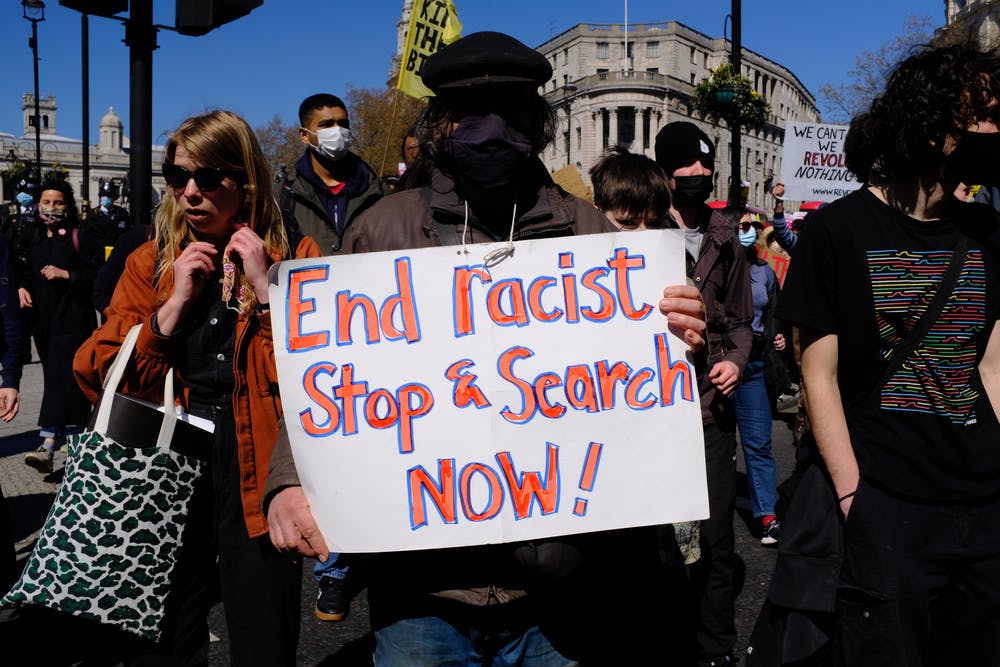
Specific groups are disproportionately affected. A 2019 US study found that women are two-to-five times more likely to be falsely identified, while the risks are ten-to-100 times greater for black and Asian faces than white ones. Given that police already disproportionately stop and search ethnic minorities, this shortcoming in the technology could potentially even be used to sustain such practices.

Crowd in London protesting about police stop and search
Facial recognition is not necessarily part of the solution. BradleyStearn

Another risk is that police covertly install facial recognition cameras permanently. This could help the state to crack down on public protests, for example. There is already a pending legal challenge against Russia before the European Court of Human Rights over such practices, and fear of state surveillance is one reason why many want this technology banned.

Nonetheless, facial recognition has its benefits. It can help police to find serious criminals, including terrorists, not to mention missing children and people at risk of harming themselves or others.

Like it or not, we also live under colossal corporate surveillance capitalism already. The UK and US have among the most installed CCTV cameras in the world. London residents are filmed 300 times a day on average, and police can usually use the data without a search warrant. As if that wasn’t bad enough, big tech companies know almost everything personal about us. Worrying about live facial recognition is inconsistent with our tolerance of all this surveillance.

A better approach

Instead of an outright ban, even of covert facial recognition, I’m in favour of a statutory law to clarify when this technology can be deployed. For one thing, police in the UK can currently use it to track people on their watchlists, but this can include even those charged with minor crimes. There are also no uniform criteria for deciding who can be listed.

Under the EU’s proposed law, facial recognition could only be deployed against those suspected of crimes carrying a maximum sentence of upwards of three years. That would appear to be a reasonable cut-off.

Secondly, a court or similar independent body should always have to authorise deployment, including assessing whether it would be proportionate to the police objective in question. In the Met, authorisation currently has to come from a police officer ranked superintendent or higher, and they do have to make a call on proportionality – but this should not be a police decision.

We also need clear, auditable ethical standards for what happens during and after the technology is deployed. Images of wrongly identified people should be deleted immediately, for instance. Unfortunately, Met policy on this is unclear at present. The Met is trying to use the technology responsibly in other respects, but this is not enough in itself.

Last but not least, the potential for discrimination should be tackled by legally requiring developers to train the AI on a diverse enough range of communities to meet a minimum threshold. This sort of framework should allow society to enjoy the benefits of live facial recognition without the harms. Simply banning something that requires a delicate balancing of competing interests is the wrong move entirely.The Conversation

Asress Adimi Gikay, Senior Lecturer in AI, Disruptive Innovation and Law, Brunel University London

This article is republished from The Conversation under a Creative Commons license. Read the original article.